



By the time an engineer at Modelit opens a Jira ticket, Claude has already investigated the codebase, scoped the change, and planned the work. By the time a reviewer sees the pull request, the change has been challenged by repeated validation loops, independently graded, and carries signed evidence bound to the exact code being shipped.
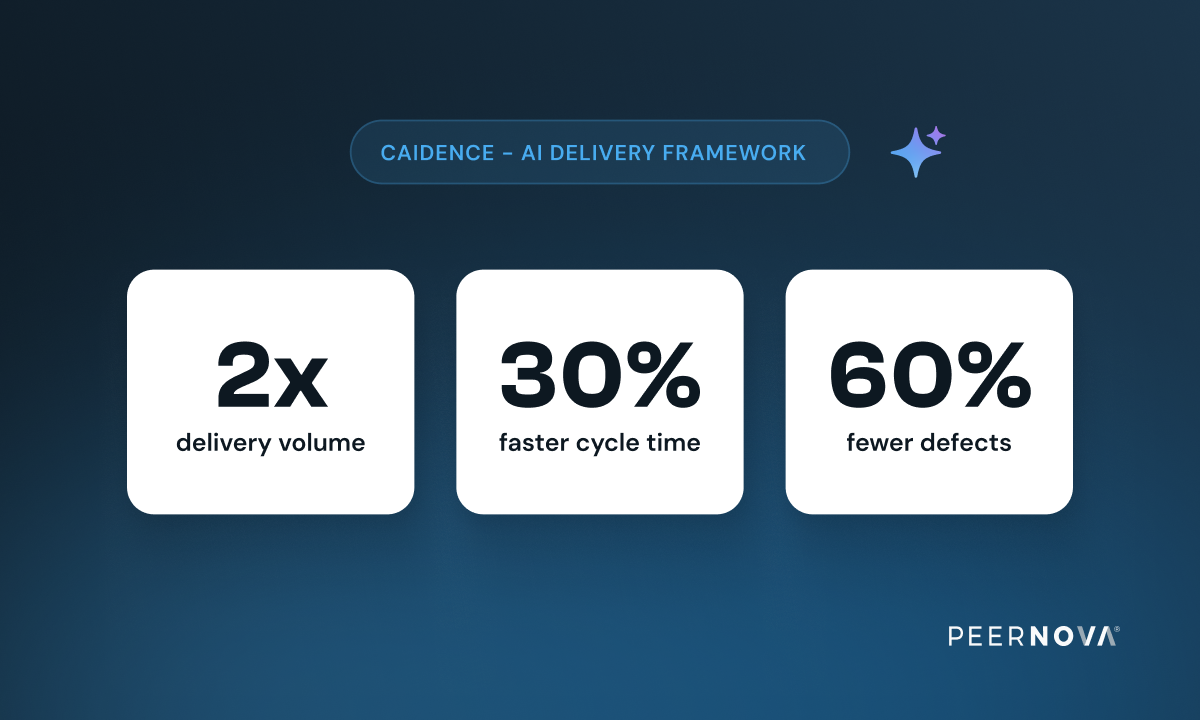
This is Caidence, the AI delivery framework PeerNova built with implementation partner Modelit to develop Cuneiform, PeerNova's Salesforce-native data intelligence product. After the Cuneiform team adopted it in March 2026, delivery volume doubled, median cycle time fell 30%, and bugs dropped from 20.3% to 8.1% of shipped work.
With Claude, PeerNova was able to :
- Double delivery volume, from 637 to 1,286 completed tickets across matched 170-day periods
- Cut median cycle time 30%, from 7.3 days per ticket to 5.1
- Cut defect work 60% as a share of delivery, with bugs falling from 20.3% of shipped work to 8.1%
- Expand feature delivery, from 32 stories before Caidence to 239 after adoption
- Ship changes with machine-verified review evidence bound to the exact code being released
The challenge
Prompts made individuals faster. Delivery stayed flat.
By late 2025, PeerNova was no longer asking whether AI could help engineers write code faster. The team was already using Claude and seeing individual productivity gains. The harder question was why those gains were not translating into faster software delivery.
The team started with the obvious lever: better instructions. Engineers refined prompts, documented standards, and carried lessons from one session into the next. Claude became better at producing the work, but the surrounding delivery process stayed largely the same.
The bottleneck was not typing code. It was everything required to trust the result: reviewing changes, checking that acceptance criteria were actually met, finding missing tests and regressions, and sending incomplete work back for another pass.
Instructions could guide Claude, but they could not guarantee that a step happened, prevent a prohibited action, verify the final result, or preserve every lesson across sessions.
PeerNova and Modelit concluded that improving prompts would not be enough. They needed to turn the delivery process itself into software.
The solution
Turning delivery into an AI-driven pipeline
PeerNova and Modelit built Caidence around Claude so the model would operate inside a defined delivery system rather than as a standalone coding assistant.
A ticket begins with one command. Claude reads the Jira story, investigates the codebase, and builds a scope. The analysis repeats until a complete pass surfaces nothing new. Caidence then decomposes the work into subtasks and Claude implements them individually, on isolated branches, with commits tied back to the acceptance criteria they satisfy.
The goal is not simply to generate code faster. It is to carry the work from intent through implementation and verification using the same repeatable process every time.
Verification became part of the work
After implementation, Caidence turns Claude against the change it just produced.
A validation loop searches for issues such as missing tests, dead code, unhandled errors, and acceptance criteria that were restated rather than actually fulfilled. The loop can run for up to ten rounds and stops only after two consecutive passes find nothing new. When it identifies a problem, the finding enters a fix loop and validation begins again.
Caidence separates execution from judgment. Claude Sonnet handles well-defined implementation work, while Claude Opus handles higher-judgment tasks such as validation, grading, and adversarial review. Every dispatched agent declares its model explicitly so routing is part of the framework rather than an informal convention.
The model that produced the work is also not the only model allowed to judge it. A multi-model review panel includes an independent model from another provider, and work below the required grade returns to the fix loop.
"Done" became something the system proves
Once validation and grading pass, Caidence creates signed review evidence, attaches it to the Jira ticket, and binds it to the exact code being proposed for release.
If the evidence is missing, invalid, or belongs to an earlier version of the change, the pull request is blocked.
That changed the role of review. Instead of asking a person to reconstruct whether every delivery step happened, the pipeline produces evidence that those steps ran against the code being shipped.
"Done" became something the system proves rather than something anyone declares.
Guardrails that act instead of remind
PeerNova and Modelit also separated rules that can be enforced from guidance that still requires judgment.
Rules a program can verify became hooks. If Claude or an engineer attempts a prohibited action, such as committing directly to a protected branch or bypassing a required code check, the framework blocks it. The denial also explains what must happen before the action can proceed.
Rules that cannot be deterministically enforced remain written guidance and are identified as such.
Around the pipeline sits persistent project memory and live connections to systems including Jira, GitHub, and Salesforce. Claude can work from current project state and accumulated knowledge rather than relying on whatever context happens to fit inside one session.
The Cuneiform team adopted the framework on March 11, 2026. Repository history shows the transition clearly: commits following Caidence conventions went from zero in February to complete adoption by April.
The outcome
Twice the delivery, with less work coming back
Across matched 170-day periods before and after Caidence adoption, the Cuneiform team increased completed tickets from 637 to 1,286.
At the same time, median cycle time fell from 7.3 days to 5.1 days.
The quality mix moved in the same direction. Before Caidence, bugs represented 20.3% of delivered work. After adoption, they represented 8.1%, a 60% reduction in defect work as a share of delivery.
Feature work expanded as well. The team delivered 32 stories in the period before Caidence and 239 in the period after adoption.
The result was not simply more AI-generated code. Verification that previously depended on people reconstructing each change now runs inside the delivery pipeline. Engineers can run multiple workstreams while the framework continuously checks whether each one meets the team's standards.
Caidence has since expanded beyond code delivery. PeerNova and Modelit are applying the same approach to product documentation, release notes, and backlog maintenance, using structured workflows and verification rather than treating each AI interaction as an isolated prompt.
For PeerNova, the shift was from using Claude to accelerate individual tasks to building a delivery system around Claude that could carry, verify, and remember the work.
Modelit is PeerNova's implementation partner for Cuneiform and a co-builder of the Caidence framework.


