
SALESFORCE CLOUD
Salesforce Data 360 helps you unify customer data, improve data quality, and govern information across the Salesforce ecosystem. The combination of Data Cloud, MuleSoft, and Tableau creates a reliable, connected foundation that your teams can trust.
Modelit helps you implement Salesforce Data 360 with the right strategy so your data supports better business decisions.
Talk to an Expert
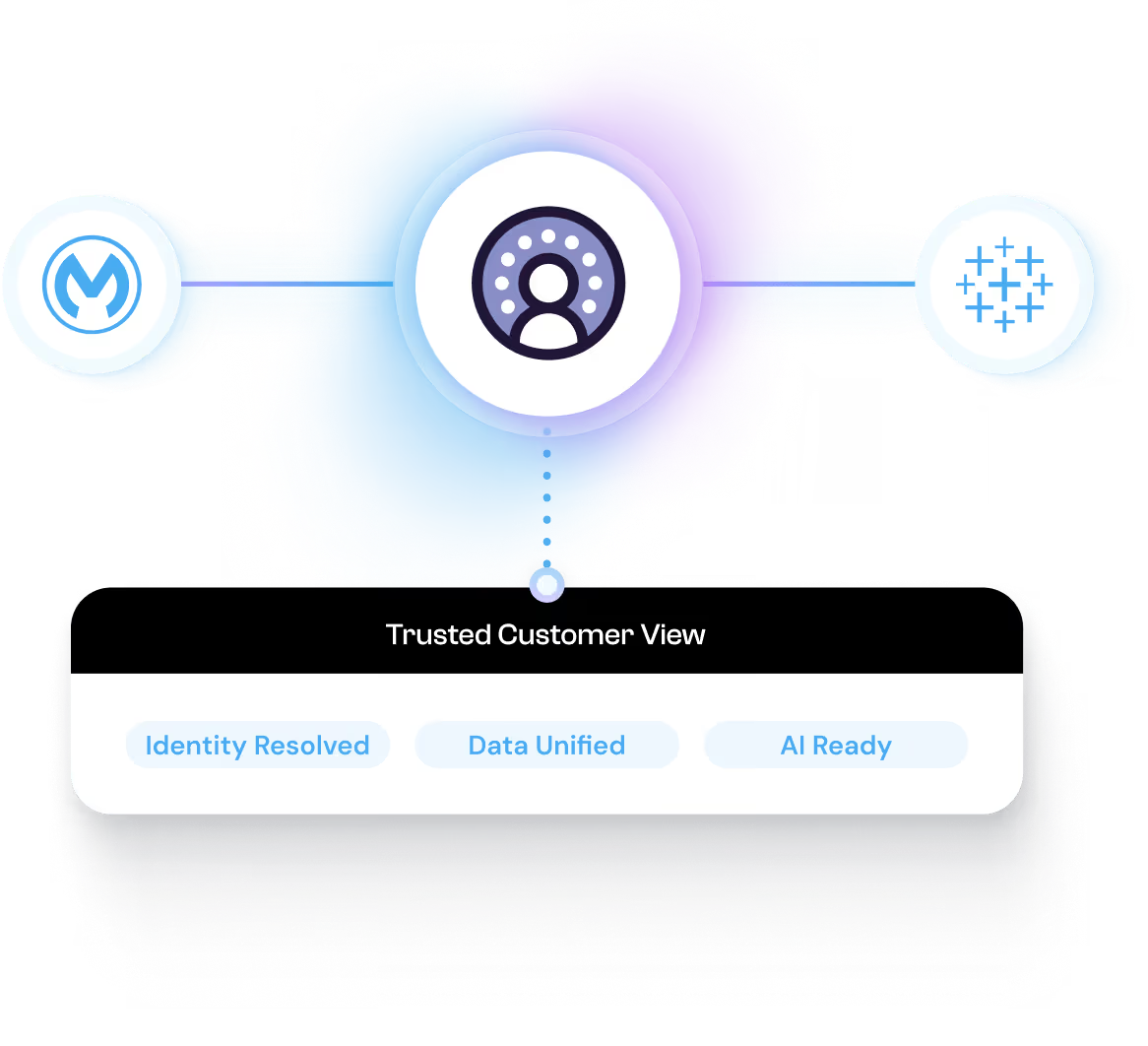

Data 360 connects, harmonizes, and activates customer data across Salesforce and external systems.
With Salesforce Data 360, you can:
Connect data from Salesforce clouds and external systems
Resolve identities across sources
Enforce data quality and governance standards
Activate trusted data across analytics, AI, and customer experiences
Turn fragmented data into a foundation your teams can confidently use.
Customer data struggles rarely come from a lack of tools. They often arise due to scattered, inconsistent, and unreliable data.
Common challenges include:
Sensitive customer data scattered across multiple orgs and external systems
Inconsistent definitions for key data like accounts, contacts, and transactions
Poor data quality that undermines reporting and AI initiatives
Teams relying on manual workarounds or spreadsheets to fill gaps
Without a unified data strategy, even the best Salesforce implementations fall short.
Salesforce Data 360 aligns integration, data management, and activation under one strategy so your teams can trust and use customer data.
Connect Salesforce data with external systems using Data Cloud and MuleSoft, creating a unified data foundation without heavy custom work.
Match and unify customer records across systems to create accurate, complete customer profiles.
Standardize data definitions, enforce rules, and ensure compliance so teams can trust data and meet compliance requirements.
Make unified data available across Salesforce apps, analytics, and AI use cases, including Agentforce and Einstein, for smarter decision making and automation.
Success with Salesforce Data 360 depends on strong architecture, clear governance, and long-term adoption. Modelit brings deep Salesforce and data expertise to guide you at every stage.
Beyond connecting your data, we aim to make it usable, trusted, and scalable.
Salesforce Data 360 strategy and architecture design
Data Cloud implementation and configuration
MuleSoft and external system integrations
Identity resolution and data model alignment
Data governance, security, and compliance planning
Enablement for analytics, AI, and agentic use cases
Have questions? Here are some of the most common things clients ask us.
Data 360 is Salesforce's framework for unified customer data: a single, real-time, complete view of every customer assembled from every system you use. It's powered by Salesforce Data Cloud and made available across every Salesforce product, including Sales, Service, Marketing, and Agentforce. The point isn't the data itself — it's that every team and every AI agent in your org sees the same customer the same way.
Data 360 is Salesforce's architecture for unified customer data. Data Cloud is the product that powers it. Think of Data 360 as the outcome, a complete and connected view of your customer, and Data Cloud as the technology that makes it possible. When you implement Data 360 with Modelit, we're using Salesforce Data Cloud to get you there.
Directly. Agentforce agents make decisions and take actions based on the data they can access. When your data is unified in Data 360, Agentforce has a complete picture of every customer: their history, their preferences, their open cases, their recent activity. That's what allows it to give relevant, accurate responses instead of generic ones.
Scope determines timeline. Our Quick Start to Data 360, which covers two data sources and gets you to a working production environment, takes four weeks. A full multi-source implementation typically runs eight to sixteen weeks depending on the number of systems involved and the state of your data.
If your teams are making decisions based on incomplete or inconsistent customer data, if you've purchased or are considering Agentforce or other Salesforce AI tools, or if you're running multiple Salesforce clouds and struggling to get a unified view, Data 360 is likely the right move. Start with our free Data Cloud Readiness Assessment to find out.
Traditional CDPs are built for marketing use cases and usually live outside your CRM. Data warehouses like Snowflake or BigQuery are built for analytics and reporting, not real-time customer engagement. Data 360 is built specifically to feed Salesforce workflows and AI agents in real time, with native integration into the products your teams already use. If you only need analytics, a warehouse is cheaper. If you need to power real-time customer experiences and AI agents inside Salesforce, Data 360 is built for that job.
Data Cloud uses consumption-based pricing tied to credits, with credits consumed by data ingestion, identity resolution, segmentation, and activation. Total cost depends heavily on data volume and how actively the unified profiles are used. Our Quick Start to Data 360 includes a credit use forecast specifically to give you a defensible number before committing.


Salesforce Data 360 sets the foundation for analytics, AI, and personalized customer engagement. Modelit helps you design and implement it with confidence.