Since May, we've read a few hundred Salesforce job postings as part of our own research. Admin, senior admin, systems admin, RevOps admin. The single most common pattern wasn't a product or a certification. It was scope.
One posting asks a single hire to own day-to-day admin, the release process, the security model, every go-to-market integration, and the company's AI strategy. Another wants admin plus developer plus Apex plus Lightning Web Components, at an entry-level salary. A third combines quoting and billing administration with building autonomous agents in Agentforce.
Each of those is a reasonable thing to need. Asking one person to do all of them is where it breaks.
How a job description gets this way
Nobody sets out to write a unicorn req. It usually happens in three steps:
- The org grew faster than the team. Salesforce started as sales tracking. Now it runs service, billing, marketing handoffs and partner data, and the admin headcount stayed at one.
- The last person did a lot of it informally. When they leave, the hiring manager writes down everything they actually did. That list is three roles long.
- AI got added at the end. "Help define our AI strategy" shows up as the last bullet, as though it were a small task.
The three jobs hiding inside the req
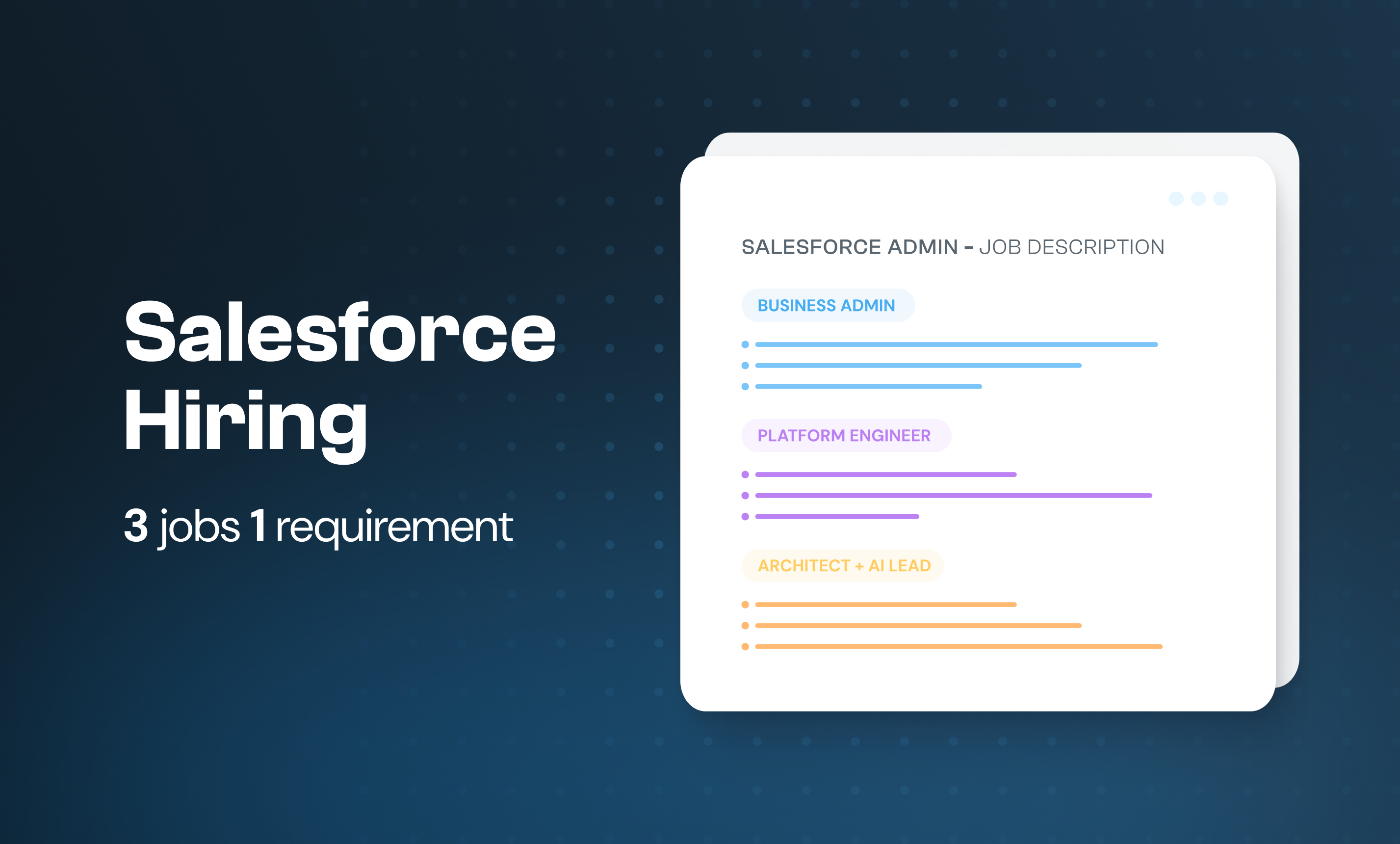
When we break these postings apart, they almost always contain the same three roles:
1. The business admin
Users, permissions, page layouts, reports, flows for everyday requests. This is the work that keeps the business moving week to week, and it's what most admins are hired and trained to do.
2. The platform engineer
Release management, sandboxes, deployment pipelines, the security model, integrations with billing, marketing automation and the data warehouse. This work is less frequent but higher risk. One bad deployment or broken sync can cost more than a quarter of tickets.
3. The architect and AI lead
Data model decisions, technical debt, and now the question of where AI fits: Agentforce, Claude connected to Salesforce, or neither yet. This is strategic work that needs time to think, which the other two jobs rarely leave.
You can find a person who is strong at one of these and decent at a second. Finding someone excellent at all three, at the salary in most of these postings, is rare. And a hire who spends every day on job one will never get to job three.
What to do instead
We'd suggest three options, depending on your size and budget.
Hire for the job you need every day. For most orgs that's the business admin. Write the posting for that role, pay for that role, and be honest in the interview about what else exists.
Cover the other two with fractional or partner capacity. Release management, integrations and architecture are bursty. A partner can own those lanes on a defined cadence while your admin owns the business. Structure it so your team absorbs the knowledge instead of renting it forever.
Make the AI piece its own decision. "Help define our AI strategy" deserves more than a bullet. AI is downstream of the data. If your data model and integrations aren't in good shape, an AI roadmap will stall no matter who owns it. Decide on the data work first, then decide who leads AI.
Want to fix yours?
Try this: sort every bullet in your current Salesforce job description into one of the three jobs above. If more than a third land outside the job you're actually paying for, the posting will either sit open or fill with someone who burns out in a year. We put together a step-by-step guide to rewriting it, with a before-and-after example and a checklist: How to Write a Salesforce Admin Job Description That Actually Gets Filled.
Where we can help
Our founders all came from Salesforce, and we've seen this pattern from both sides. Whether you're hiring, waiting on a hire, or trying to figure out which of the three jobs you actually need, we can help you cover the gaps, from fractional admin support to releases, integrations and AI.
Let's talk about your Salesforce coverage. →
Prefer to start with data? Our free Salesforce Health Check shows where your org's real load sits.