

All week at Dreamforce, we heard the same thing. AI is paying off for small teams. Scaling it across the organization is where it stalls.
The sessions explained why. Seven patterns kept coming up in the work behind every success story. (For the announcements and everything else we heard, see our Dreamforce 2026 recap.)
As a team, we attended dozens of sessions. We didn't ask what was new. We asked what work it actually took. What got built. What had to be true first. Who did it. And what kept going after launch.
The answer is less exciting than the keynotes and more useful. Strip out the product names and nearly every success story rests on data and integration work that has existed for twenty years. The AI is why the budget exists. The plumbing is the project.
What were the biggest trends at Dreamforce 2026?
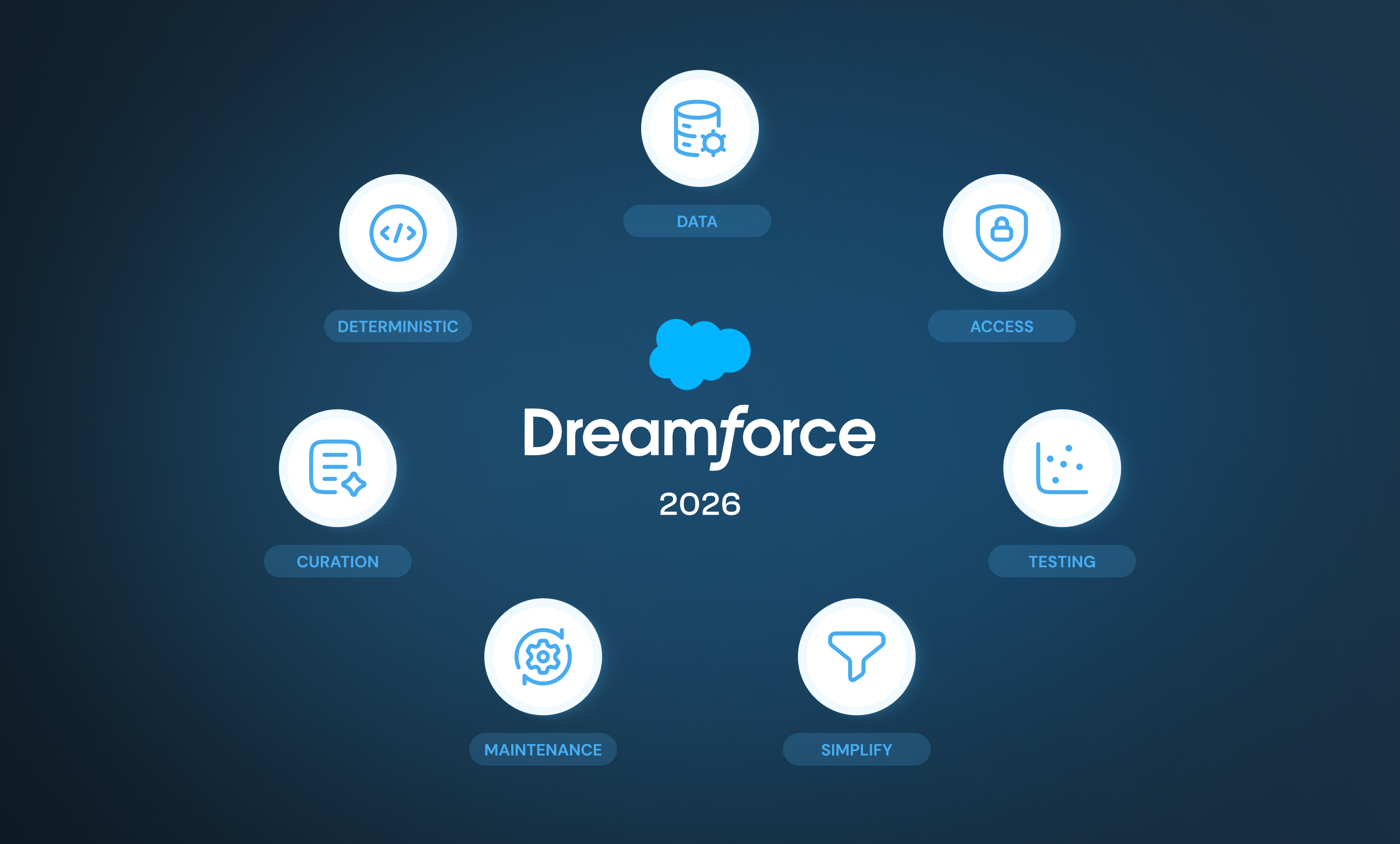
Dreamforce 2026 ran September 15–17 at Moscone Center in San Francisco. Across the sessions, seven trends stood out:
- Data unification is most of the work. Agents are only as reliable as the customer records under them.
- Simplify before you migrate. Cut fields, products, and reports before adding AI on top.
- Someone has to curate the content, continuously. Agents can only use knowledge they can find.
- Agents need their own access controls. Sharing models built for people don't hold up to software.
- Testing an agent isn't like testing software. You need test datasets, scoring, and adversarial cases.
- Decide what stays deterministic. Let the model find things. Let code decide things.
- The work doesn't stop at go-live. Agents drift and need ongoing maintenance.
1. Data unification is most of the work
This came up more than anything else. It's the precondition for everything built on top.
The scale is worth noting. Pearson consolidated 60 CRM instances down to a legal minimum, over about a decade, before voice routing was feasible. Fresenius unified 100 countries and four business lines onto one CRM in eleven months. The Smithsonian merged 21 museums off hundreds of legacy systems. Nestlé spent roughly four years unifying 15 data domains across 8,000+ technologies. A 92-year-old credit union consolidated around 45 systems into a single member view. It was presented as an AI result. It was built almost entirely on years of data management.
What identity resolution means. A customer exists as "Maria Gonzalez" in one system, "M. Gonzalez" in another, and an email address on the mailing list. Three records, one human. Identity resolution is the work of recognizing that and merging them.
For reporting, duplicates are an annoyance. For an agent, they're a correctness problem. Ask "how much has Maria spent?" and it answers confidently from whichever record it found. It has no way to know the other two exist.
The work runs in four steps:
- Ingest and map. Pull each source into a common model.
- Match. Exact on email or phone. Fuzzy on names and normalized addresses.
- Reconcile. When matched records disagree, decide which value wins.
- Output. One profile per person.
Steps one and two are technical. Step three is a business decision dressed up as a technical one. Nobody in IT can tell you which system has the right address. That depends on which team maintains its data properly, and the answer changes field by field. That's where the time goes.
One session described an agent mailing a letter addressed to a customer's deceased husband. The system had the information. Nothing had reconciled it.
2. Simplify before you migrate
A steady message across sessions: don't lift and shift complexity.
The numbers are hard to ignore. Workday cut its Account object from 900 fields to about 150 through a field-by-field review before rebuilding a twenty-year-old org. One manufacturer went from roughly 2,000 configurable products to 165. IBM collapsed 77,000 forecasting reports into 100 dashboards before putting agents anywhere near them.
Every customer on one migration panel gave the same advice without being asked: analyze and simplify first.
This is the least glamorous trend on the list and possibly the most important. An agent reasoning over 900 fields, most unused and half undocumented, will produce confident nonsense. Removing what you don't need is worth more than adding intelligence on top of it.
3. Someone has to curate the content, continuously
Agents are only as good as what they can find. A lot of the work we heard about was making content findable in the first place.
The clearest example came from a live demo. A support dataset scored 42 out of 100 for AI readiness because the agent could see one of eight relevant knowledge articles. Fixing two issues lifted it to 73.
A UK police non-emergency line had to write and maintain about 90 knowledge articles. One marketing team processed 300,000 call transcripts and 2 million support cases before campaign work could start. One consultant's checklist was refreshingly boring: add data-quality formula fields, and fill in the descriptions on your objects, fields, and flows. Agents rely on metadata the way people rely on tribal knowledge.
The line that stuck came from ADP. Agents run on the same knowledge people use. People just compensate for the gaps without noticing.
This work doesn't end. One consumer goods company keeps a running log of questions its agent couldn't answer and uses it to fix the knowledge base.
4. Agents need their own access controls
This came up again and again. The message: the defaults are wrong.
Salesforce's standard MCP server ships with broad access to effectively any object. MCP (Model Context Protocol) is the standard that lets an AI assistant query your org. See how it works in practice.
Practitioners treat that default as a defect, not a convenience. One partner replaced it with four purpose-built tools, two read-only and two that can write, to keep a language model from wandering across a financial workflow.
Another session mapped four separate trust boundaries for AI running outside the Salesforce UI. It named the anti-pattern plainly: elevated service accounts called from anonymous sessions.
One company's 70-user pilot included deliberate "should NOT see" tests. They proved the agent couldn't reach certain records, not just that it could reach the right ones.
The core problem is simple. Most sharing models were designed for people who click. They've never been tested by something that queries at machine speed.
Agentic identity, where agents get their own lesser-privileged credentials instead of borrowing a user's, goes GA in November.
5. Testing an agent isn't like testing software
You can't test a probabilistic system the way you test a form. Teams are building real infrastructure to cope.
Xero built a human-curated dataset of 1,000+ records plus custom scorers for empathy and tone, across 44 versions in twelve months. The UK policing agent ran roughly 3,000 test conversations with operational staff before sign-off. One manufacturer ran 150 scripted scenarios in about a week. Two financial firms built 1-to-5 scoring rubrics and replayed real production conversations against sandbox builds.
ADP's conclusion: only AI can test AI. They now generate adversarial scripts and simulated calls automatically.
If you're evaluating a proposal, ask two questions. What will it be tested against? And what happens when it fails?
6. Decide what stays deterministic
Deterministic means the same input always gets the same answer: a query, a rule, a formula. This was the design decision that came up most among people who had actually shipped something. It's what separates working agents from impressive demos.
A youth organization serving 400,000 members built a member-services agent. Semantic search returned results that were mostly right: the right activity, the wrong age group or location. Fine for browsing. Useless for registering a child.
They rebuilt it in three stages:
- Explore. Semantic search finds candidates.
- Qualify. The AI extracts structured criteria, then an exact database query filters.
- Act. Registration runs on rails.
The same pattern kept showing up. A pharmacy benefits manager hard-coded drug pricing into a guided response rather than trust a language model with regulated answers. An airline keeps final decisions in deterministic logic and lets the AI handle only the conversation.
The rule of thumb: let the model find things. Let code decide things. Especially anywhere a wrong answer has real consequences.
7. The work doesn't stop at go-live
Plenty of teams described work that recurs rather than ends. It's the most under-described part of any AI story.
One company's coding agent analyzes every call transcript and edits its own instructions in a continuous loop. The policing agent gets a weekly review of its instructions and guardrails, because escalation errors carry life-safety consequences. Two organizations run live quality dashboards to find which sub-agents need better grounding.
Agent behavior drifts. The data changes, people ask things nobody expected, and the model updates. Treating an agent as a delivered project instead of a maintained system is the most common planning mistake we saw.
A caveat about the evidence
Conference case studies are picked to be encouraging. It's worth noticing who was on stage.
The nonprofit serving 400,000 members had a Director of IT and built inside a vendor accelerator backed by more than $16 million in grants and $1 million in pro bono time. A 13-location contractor's project was driven by its COO. An insurance brokerage has a full-time Salesforce administration manager. One well-known "we built it ourselves" story came from a VP who previously ran Salesforce at Amazon.
That's not a knock on those teams. They did good work, and their failures are the most useful material in the whole set. But their staffing and timelines aren't a benchmark for an organization where three people each wear four hats.
A panel of smaller companies closed with exactly that advice: partner, rather than build agents alone.
The shape of it
Four of these seven trends are work that has existed for decades: consolidating data, simplifying schemas, curating content, and managing rollout. What changed is that an AI project now brings the budget and the urgency to finally do it.
The other three are new: testing probabilistic systems, access control for agents, and deciding what stays deterministic. Almost nobody has a settled practice for them yet.
If you're planning for next year, that's the honest ratio. Most of the effort goes into work that isn't AI.
Dreamforce 2026 trends FAQ
What were the main trends at Dreamforce 2026?
The sessions kept coming back to seven: data unification, simplifying before migrating, continuous content curation, access controls for agents, testing agents, deciding what stays deterministic, and maintaining agents after go-live. Most are data and process work, not AI.
What is identity resolution in Salesforce?
Identity resolution matches and merges records that belong to the same person across systems, like "Maria Gonzalez" in one system and "M. Gonzalez" in another. Without it, an AI agent answers from whichever record it finds first.
Why do AI agents need their own access controls?
Most Salesforce sharing models were designed for people clicking through the UI. Agents query at machine speed and can reach far more records. Agentic identity, GA in November 2026, gives agents their own lesser-privileged credentials.
How do you test an AI agent?
Build a curated test dataset, score responses against a rubric, and run adversarial and "should not see" tests. Replay real conversations against sandbox builds before and after every change.
What does deterministic mean for an AI agent?
A deterministic step always gives the same answer for the same input, like a database query or a rule. The common pattern is to let the AI search and interpret, and let deterministic logic make final decisions.
What happens after an AI agent goes live?
Its behavior drifts as data, questions, and models change. Teams that succeed review instructions and guardrails regularly, log unanswered questions, and monitor quality dashboards.
Where to start
Pick one team and one job. Fix the data for that job. Test it, lock down what it can see, and plan who maintains it. Then scale.
See where you stand. Take the AI Journey Assessment. Eight questions, three minutes, and you get your next steps.