

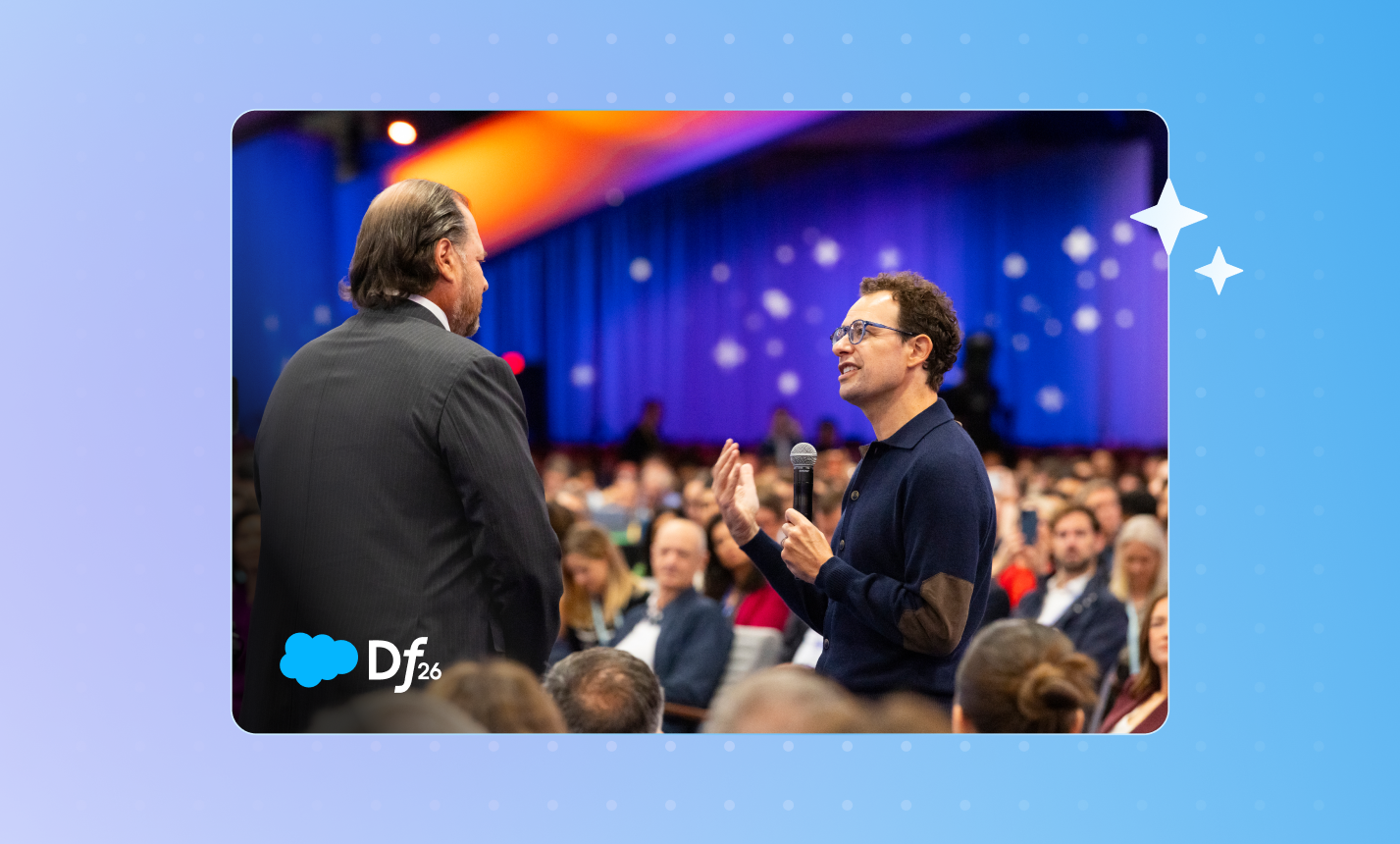
Dreamforce 2026 had plenty of star power.
Marc Benioff launched AIforce and called the "SaaSpocalypse" talk "crazy nonsense." He also said we cannot let AI become social media 2.0. Jensen Huang shared a stage with Anthropic's Dario Amodei, and the two disagreed about whether AI needs new rules. Huang said it doesn't. He called safety an engineering problem.
Two of the most powerful people in tech debated the future of AI. Neither mentioned duplicate contacts.
Then came the flagship demo. A personal command center, built in Claude, with live pipeline views and a talking avatar delivering a deal briefing. It looked great. No deal moved forward on stage.
That's not a knock on the demo. It was fun, and the technology is real. But it's a fair summary of the week. AI showed up this year. The work that makes it pay off is still data, process, and permissions. None of that fits in a keynote.
Dreamforce 2026 recap: the short version
Dreamforce 2026 ran September 15–17 at Moscone Center in San Francisco. If you only have a minute:
- AI is past the pilot question. The conversation moved from "does it work" to "how do we roll it out."
- The biggest announcement was Claudeforce, the Salesforce and Anthropic partnership that brings Claude into Salesforce. Salesforce in Claude is in beta now.
- Agentic identity goes GA in November. Agents get their own, lesser-privileged credentials.
- Custom MCP servers let AI call what you build on Salesforce, with your sharing rules intact.
- Org-wide AI ROI still depends on data, permissions, and maintenance. Small teams can see the return. Scaling it is plumbing work.
What did Salesforce announce at Dreamforce 2026?
First, the names. Agentforce, AIforce, Coworker, Vibes, Agentscript, Claudeforce. One product was renamed the week before the event. At least three different "Max" editions came up across sessions. If you need a glossary, you are not alone.
Here's what matters, with dates where there are dates:
- Claudeforce. The Salesforce and Anthropic partnership that puts Claude to work inside Salesforce. There's a sales plug-in, and a separate developer plug-in for Claude Code that ships through Anthropic's marketplace with about 40 core platform skills. Salesforce in Claude is in beta on all paid Claude plans. Admins can request beta access on AgentExchange.
- Agentic identity. Agents get their own, lesser-privileged credentials instead of borrowing a user's. GA in November.
- Custom skills in Agentforce Studio. In pilot now. Live in October.
- Custom MCP servers. MCP (Model Context Protocol) is the standard that lets AI tools call your systems. You can now build your own Salesforce MCP tools backed by Apex, Flows, REST endpoints, or named SOQL queries. ISVs can package them starting with the spring release. For examples, see practical Claude and Salesforce MCP use cases.
- Claude Sonnet is Agentforce's default model. Developer editions ship with Claude turned on, which makes it cheap to try before anyone signs anything.
The custom MCP piece is the one I'd pay attention to. Salesforce is still the best platform for building business applications. Now AI can call the things you build on it, with your sharing rules intact. That's a bigger deal than any avatar.
Our Dreamforce 2026 takeaways
Here's what we heard in conversations all week, and what the sessions told us about why.
Where people are
AI is real this year. Last year the question was whether it works. This year the question is how to roll it out. Nobody asked us if agents were a fad. Plenty of people asked how to get one past their security team.
Companies are standardizing, just not on the same thing. Some picked Agentforce. Some picked Claude. Others went with ChatGPT or Copilot. There's no single winner yet, and most organizations are just getting started.
A few advanced users mix platforms to save money. They send the easy job to the cheap model and the hard job to the expensive one. That's not disloyalty. That's budgeting.
The gap
The ROI is clear for a small group. The org is another story. A small team with a narrow job can see the return. Scaling that across the whole organization is where the math gets hard. People are still working through it.
Why the gap exists
Most of the work isn't AI. As a team, we attended dozens of sessions and kept asking one question: what work did this actually take? Three trends explain the gap better than anything else.
1. Data unification is most of the work. One customer, three records, three systems. An agent will answer confidently from whichever one it finds. Merging them is a business decision as much as a technical one, and it's where the time goes. Workday cut its Account object from 900 fields to about 150 before rebuilding. An agent reading 900 fields will produce 900 fields' worth of confidence.
2. Agents need their own access controls. The standard MCP server ships with broad access. Practitioners treat that as a defect. Most sharing models were built for humans who click, not software that queries at machine speed. A pilot for five people can live with loose permissions. A rollout to five thousand can't.
3. The work doesn't stop at go-live. Agent behavior drifts. The data changes, people ask new questions, the model updates. A small team notices and fixes it. An org needs someone whose job it is. Plan for a maintained system, not a delivered project.
That's the pattern. A small group can work around bad data, loose permissions, and drift. An organization can't. The AI is why the budget exists. The plumbing is the project.
We saw four more trends, including why testing an agent isn't like testing software. Read all seven: Dreamforce 2026 Trends.
A Golden Hoodie for Modelit's CTO
One more thing. Our CTO, Angélica Buffa, had a big week. She was inducted into the Salesforce MVP Hall of Fame. A few days later she walked onto the Data 360 keynote stage to talk about data, trusted context, and AI. She walked off wearing a Golden Hoodie.
If that topic sounds familiar, it should. It's the same argument this whole post makes, delivered from the main stage.
Sixteen years ago she was a QA engineer in Uruguay. We're proud of her, and not surprised. Read her story: The Hoodie Wasn't Really About the Hoodie.
The Modelit Dreamforce happy hour
Dreamforce is about big ideas. The best conversations usually happen offstage.
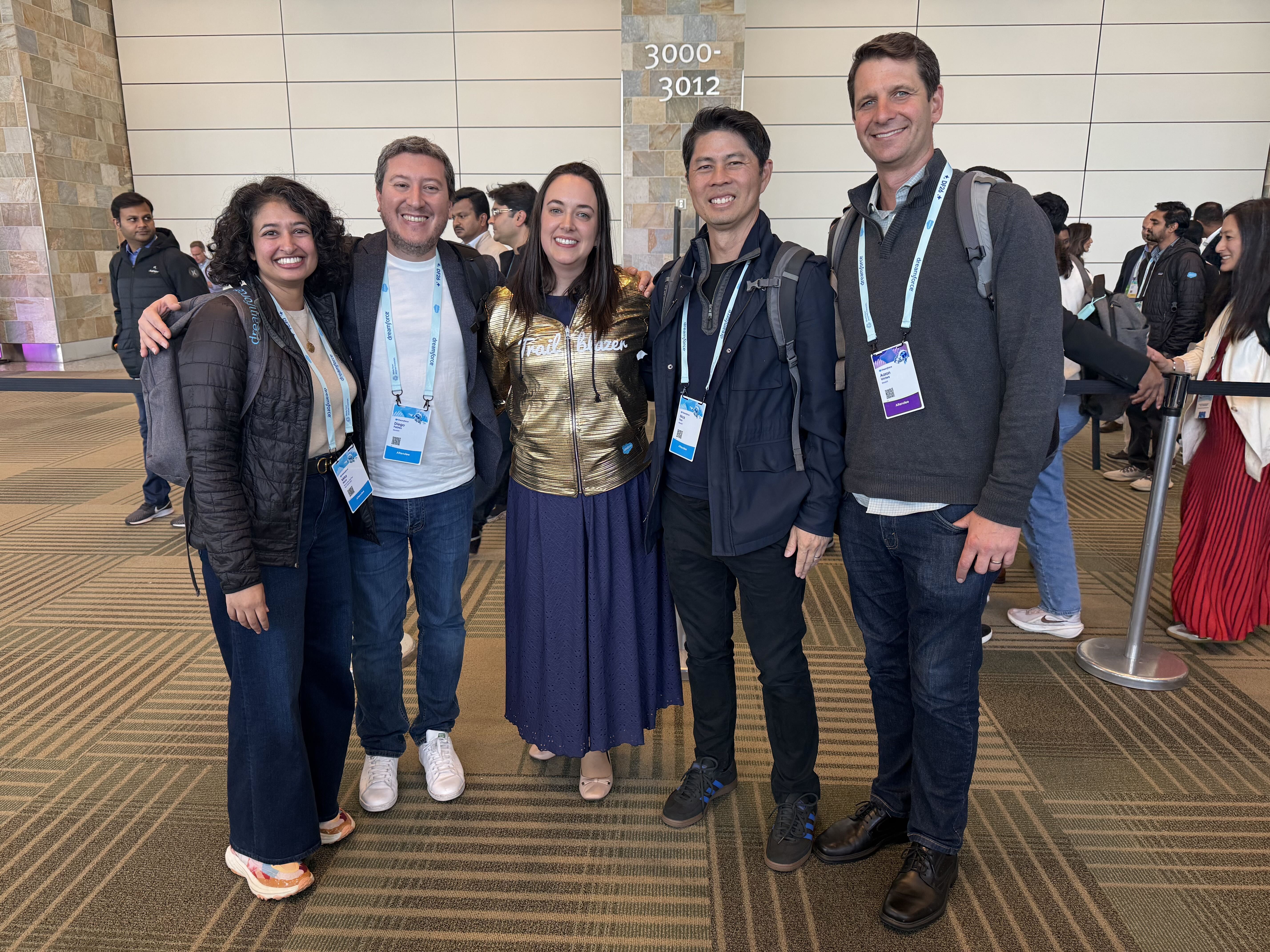
On the evening of September 15, we hosted the Modelit Happy Hour at Press Club, a few blocks from Moscone. Drinks, bites, some Modelit swag, and a room full of Dreamforce attendees, Salesforce experts, and the Modelit community. If you missed us, here's where we were all week.
Thanks to everyone who came.
The bottom line
The keynotes were about the future of AI. The sessions were about the work. The flashy part of AI is easy to demo. The part that pays off is data, process, and permissions, and it's the same work it's always been.
Dreamforce 2026 FAQ
When and where was Dreamforce 2026?
September 15–17, 2026, at Moscone Center in San Francisco, with sessions streamed on Salesforce+.
What is Claudeforce?
Claudeforce is the Salesforce and Anthropic partnership announced ahead of Dreamforce 2026. It brings Claude into Salesforce through a sales plug-in and a developer plug-in for Claude Code. Salesforce in Claude is in beta on paid Claude plans.
How do I get access to Salesforce in Claude?
A Salesforce admin can request beta access on AgentExchange. The admin connects Salesforce once, then chooses which groups get the plug-in.
What is agentic identity in Salesforce?
Agentic identity gives an AI agent its own credentials with fewer privileges than a human user, instead of borrowing a user's access. It goes GA in November 2026.
What is a Salesforce MCP server?
An MCP server exposes Salesforce data and actions to AI tools through the Model Context Protocol. With custom MCP servers, you choose exactly which Apex, Flows, or queries an AI can call, and your sharing rules still apply.
Why is AI ROI hard to prove across a whole organization?
Because a small team can work around duplicate records, loose permissions, and agent drift. An organization can't. Scaling AI depends on unified data, access controls built for agents, and someone maintaining the agent after launch.
What to do Monday
You don't need a strategy deck. You need a starting point.
- Pick one team and one job. Not "AI for sales." Something like "draft follow-up emails after discovery calls." Narrow enough to measure.
- Fix the data for that job. Just the objects and fields it touches. Dedupe them, describe them, and lock down who and what can see them.
- Measure before you scale. Time saved, errors caught, work that actually changed. If the number is real for one team, you have your business case for the next one.
Then do it again. That's how a small win becomes an org-wide one.
See where you stand. Take the AI Journey Assessment. Eight questions, three minutes, and you get your next steps.